
How we help organizations integrate artificial intelligence into operational processes
See examples of how companies and institutions gradually replace manual tasks, centralize knowledge, and take control of their processes.
What we implement for our clients
- AI assistants that take over the onboarding of new employees.
- Centralized knowledge that was previously distributed across documents and people.
- Visualization of processes that previously existed only in people’s heads or in unusable documents.
- Replacement of manual report creation with automated analysis assistants.
- Connecting existing ERP and CRM systems with AI interfaces for natural interaction.
- Tailor-made process optimization.
Examples of operational intelligence in organizations
SCENARIO 1: Onboarding and training of employees
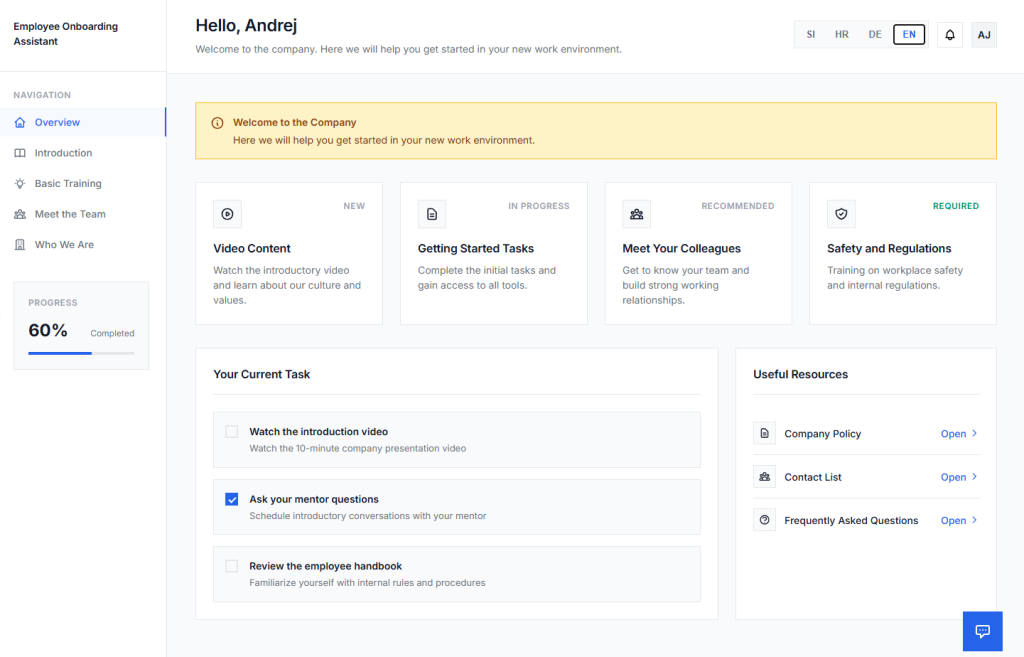
What happens at the client:
New employees get access to an internal AI assistant that knows workflows, rules, and internal documents.
Answers are not generic but based exclusively on internal data.
Questions no longer interrupt the work of key personnel.
What changes:
shorter onboarding,
fewer operational interruptions,
reduced dependency on individual people.
SCENARIO 2: Centralization and protection of knowledge
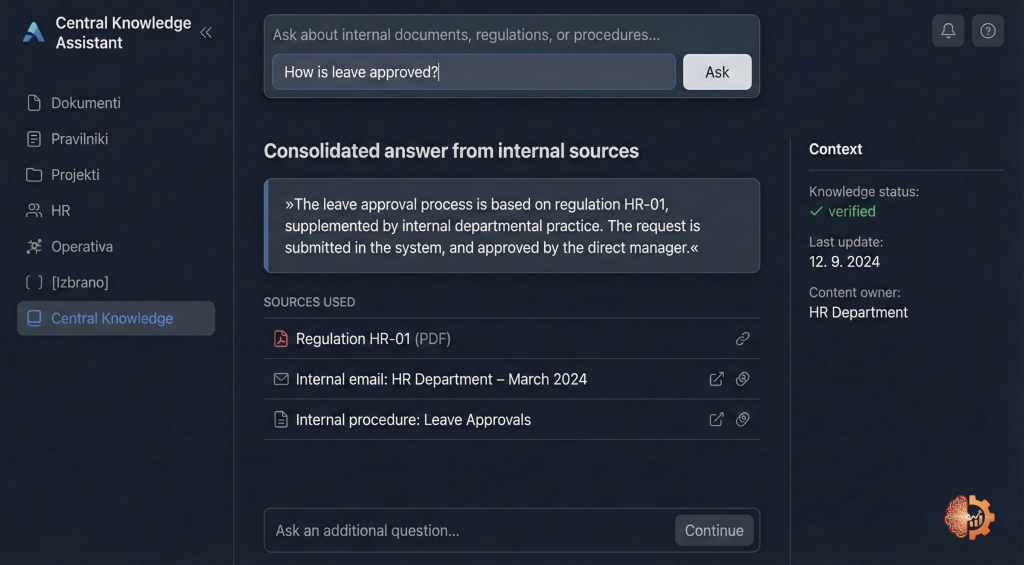
What happens at the client:
Distributed documents, policies, and emails are merged into a single knowledge source.
The AI responds consistently, regardless of who asks.
Knowledge remains within the organization even when staff change.
What changes:
less searching,
fewer misinterpretations,
greater operational stability.
SCENARIO 3: Visualization and understanding of processes
What happens at the client:
Processes are not just “drawn”, but visualized in a way that allows them to be controlled, monitored, and improved.
We introduce visual layers that make complex workflows understandable in practice for management and teams.
Typical forms of visualization:
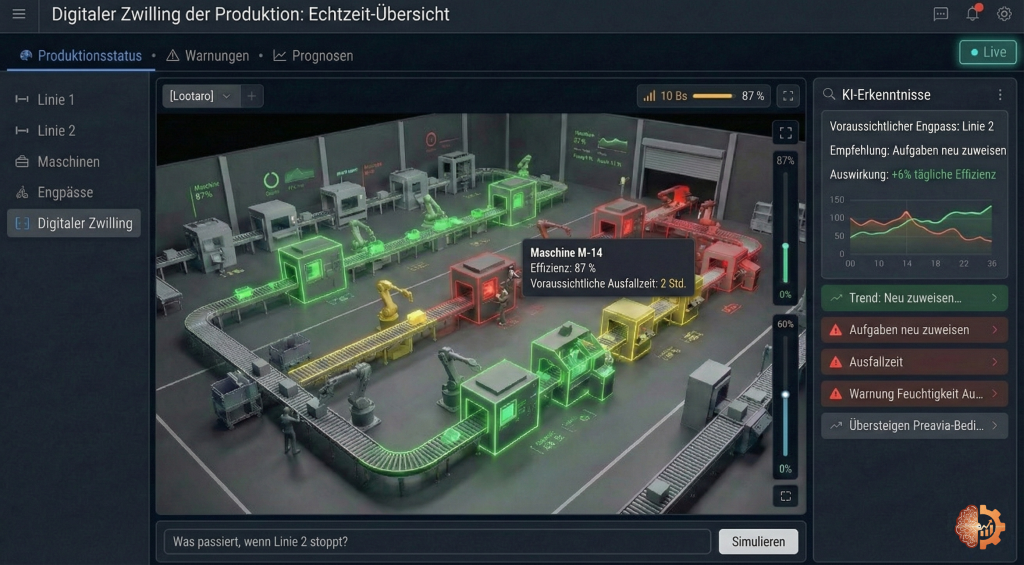
Digital twins (production / logistics): visual representation of states, workflows, bottlenecks, and changes in real time or based on simulations.
Video onboarding and micro-learning: workflows and rules are turned into short, targeted video content that standardizes training and reduces dependency on mentors.
AI-generated decision notes: meetings and decision processes produce structured notes – context, arguments, decision, task owner, risks, “why” – so the organization does not go in circles.
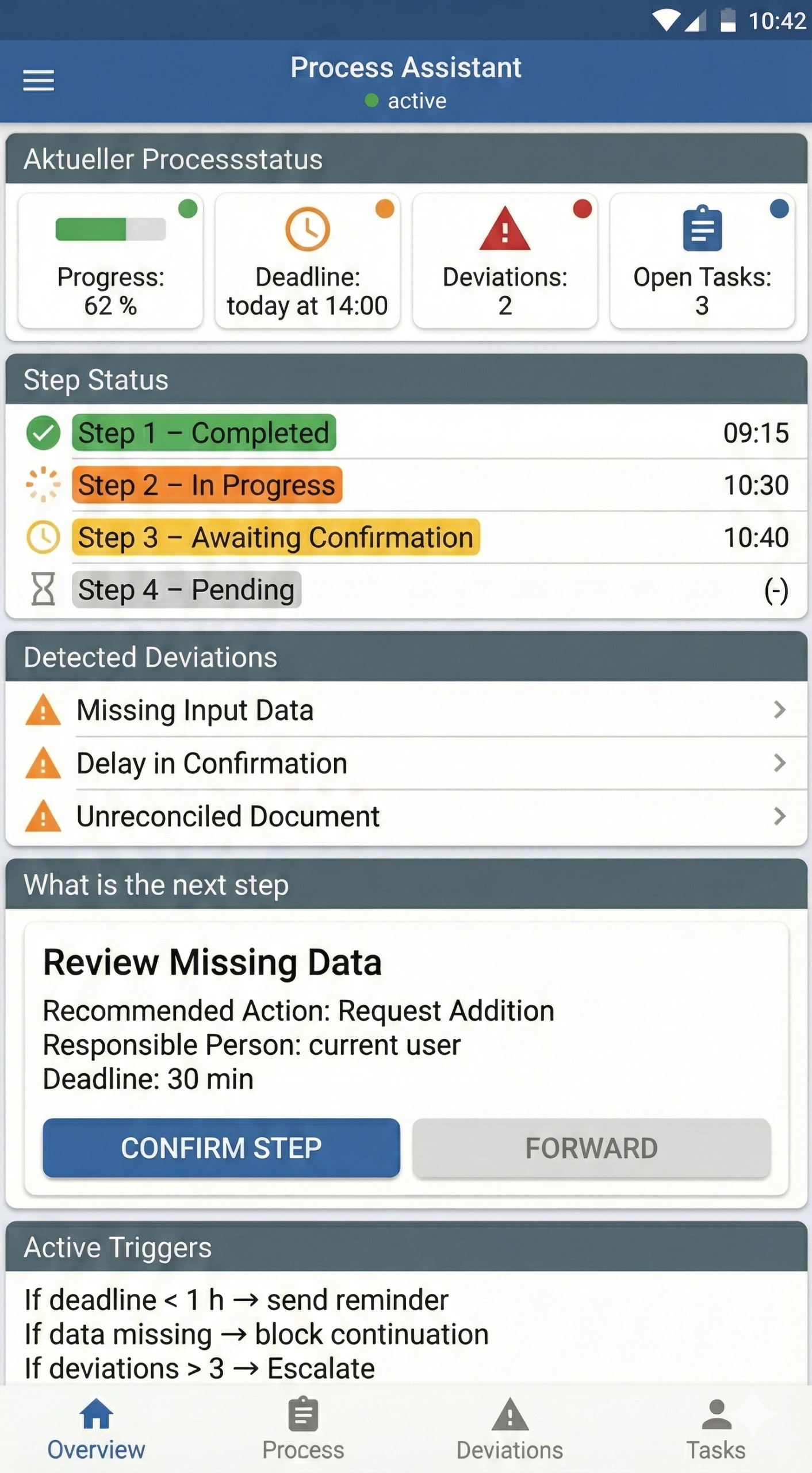
Visual control dashboards for processes: simple views of KPIs, status, deviations, and triggers, clearly showing “what is happening” and “what the next step is”.
What changes:
fewer misunderstandings and “lost context”,
faster alignment and execution,
better decisions (through traceability),
processes become controllable without constant explanation.
This is not about prettier diagrams.
It is about the organization seeing and steering its actions more directly.
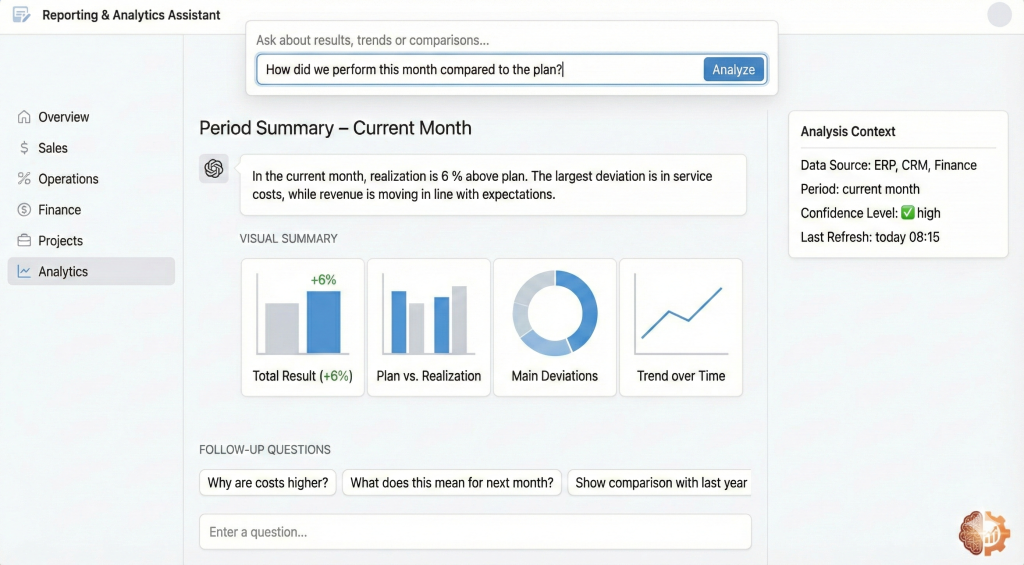
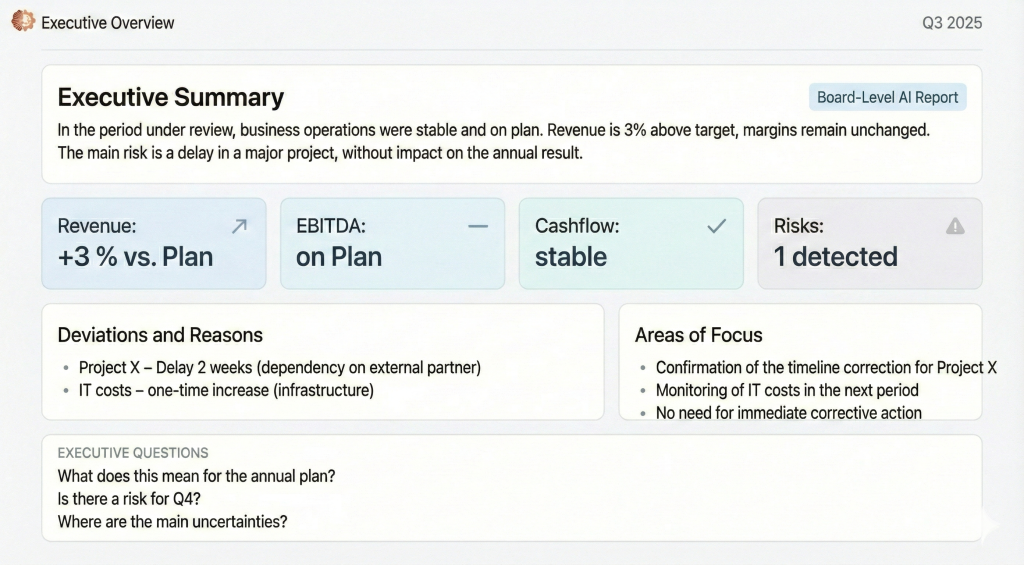
SCENARIO 4: Reporting and analytics
What happens at the client:
Reports are generated automatically from existing systems.
Analyses are available in natural language, without spreadsheet preparation.
Management no longer waits for manual summaries.
What changes:
faster decisions,
less administration,
more time for substantive discussions.
SCENARIO 5: Operational control and compliance
What happens at the client:
AI monitors process execution and points out deviations.
Policies and legislation are no longer passive documents.
Compliance becomes part of the operational workflow.
What changes:
fewer errors,
less reactive firefighting,
more control without additional staff.
SCENARIO 6: System integration and natural interaction
What happens at the client:
ERP and CRM systems are controlled via natural language.
Operational tasks are triggered automatically.
Manual copying and clicking lose importance.
What changes:
less operational friction,
more consistency,
better use of existing systems.
Different AI automations
E-Mail-Assistent: Sortiert eingehende E-Mails, erkennt Prioritäten und erstellt Antwortvorschläge.
Termin-Assistent: Koordiniert Termine automatisch und schlägt freie Zeitfenster vor.
Angebots-Assistent: Erstellt Angebote auf Basis weniger Eingaben und vorhandener Vorlagen.
Rechnungs-Assistent: Prüft Rechnungen, liest Daten aus und überträgt sie ins ERP.
Support-Assistent: Beantwortet interne oder externe Anfragen auf Basis des Wissenssystems.
Meeting-Assistent: Erstellt automatisch Protokolle, Aufgaben und Zusammenfassungen.
Aufgaben-Assistent: Wandelt E-Mails und Nachrichten in strukturierte To-dos um.
Daten-Assistent: Beantwortet Fragen zu Zahlen, Umsätzen, Projekten in natürlicher Sprache.
Dokumenten-Assistent: Findet Informationen in Verträgen, Richtlinien und Handbüchern.
Prozess-Assistent: Führt Mitarbeitende Schritt für Schritt durch interne Abläufe.
None of these scenarios is a large-scale project.
Each is a clearly defined intervention that delivers impact and defines the next step.
How the collaboration works
Every project starts with a single intervention that demonstrates value. Only then do we move on to the next step.
1. First step
Overview of current problems and improvement potential.
Joint analysis of processes.
Definition of a specific process to optimize.
2. Typical entry
With a limited internal assistant.
With the visualization of a specific process.
With the automation of a report or analysis.
3. Next step
Review of the optimized process.
Analysis of benefits and savings.
Transition to the next process.
Criteria
Our clients evaluate us by operational impact, not just theory.
Knowledge retention, faster decisions, reduced dependency on individuals.
The process adapts to the work and tasks – not the other way around.
Who it is suitable for
Operational intelligence is a process for introducing artificial intelligence into operational workflows for organizations that:
think long-term,
understand that AI will replace part of operational work,
want to retain control over data and knowledge,
are not looking for quick demo solutions.
A conversation about what is currently happening in your organization
We compare your situation with what is already working elsewhere.
The initial consultation serves to understand how your organization works and what it needs, and to assess whether operational intelligence delivers real value.
It takes about 45 minutes and takes place by appointment – remote or in person.
Operative intelligence
Think. Optimize. Evolve.
Herbert Zimmermann
Dimitrije Stopar
© 2026 All rights reserved.
Design: Dimitrije Stopar s.p.